


Type: Hybrid (F1)
Growth Habit: Indeterminate
Size: 6 - 8 oz.
Shape: Round
Color: Deep Red
Life Cycle: Annual (Perennial in Tropical Climates)
Characteristics:
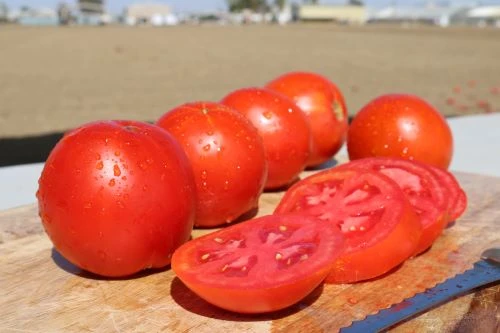
Champion III F1 Tomato is an improved indeterminate hybrid combining attractive fruit, excellent flavor, and an impressive disease resistance package. Vigorous plants with lush, dark green foliage produce 6 to 8 oz. deep red tomatoes with thick flesh and delicious flavor. The attractive fruit are round to globe-shaped with a slightly flattened profile and some ribbing, offering a larger, rounder fruit than Champion II. The addition of the crimson gene contributes to the rich red interior color, while the expanded disease resistance package supports dependable production throughout the season. With its combination of vigorous growth, attractive fruit, rich color, excellent flavor, and broad disease resistance, Champion III F1 is a strong slicing tomato for all growers.
Tomatoes (Solanum lycopersicum)
Tomatoes come in a variety of types, including fresh, beefsteak, grape, cherry, plum, paste, and more. Offering a mixture of these types can help expand your marketing potential and appeal to different customer preferences. There are two primary growth habits for tomato plants: determinate and indeterminate. Determinate tomato plants will grow to a genetically specified height and produce all of their fruiting flowers at one time. Indeterminate tomato plants continue to grow and produce fruiting flowers throughout the entire season.
Heirloom tomato varieties, which have been passed down through generations, are increasingly popular in local fresh markets. However, they are often not ideal for large-scale production due to challenges such as shipping difficulties, lack of fruit firmness, uneven ripening, disease susceptibility, and their indeterminate growth habit. In the U.S., tomatoes are primarily harvested for either processing or fresh marketing.
Temperature
Tomatoes grow best when the daytime temperature is between 65-85°F. They stop growing above 95°F. If nighttime temperatures are above 85°F, the fruit will not turn red. Tomatoes need full sun.
Soil
Tomatoes thrive in warm, well-drained soils with good air and water infiltration. It is important to conduct a soil test before planting. Based on the soil test results, lime should be applied to adjust the pH to between 5.8 and 6.6 for optimal growth.
Planting
Commercially grown tomatoes are typically started as transplants in a greenhouse 42-56 days before field planting. Since tomatoes are a warm-season crop, they should not be transplanted until the soil temperature at a 3-inch depth reaches 60°F. Raised beds covered with red or black plastic mulch are commonly used, and drip irrigation is employed to optimize plant growth, yield, and fertilizer application.
Tomato plants are typically spaced 18 to 30 inches apart in rows, with 5.0 to 6.5-foot centers, and planting densities range from 2,600 to 5,800 plants per acre. For compact tomato varieties, double rows can be planted on each plastic-covered bed, reaching up to 10,000 plants per acre. To maintain high-quality production, tomatoes require support off the ground.
Spacing
The spacing depends on the variety, the training system, and the spray equipment. On average spacing is as follows: 12-18” in row and 60” between rows.
Harvest
Harvesting fresh-market tomatoes is labor-intensive and requires multiple pickings, typically four to six times during the growing season, depending on the plant type, maturity, and market demand. Tomatoes for the wholesale market are usually harvested at the mature green to breaker stage to avoid over-ripening during shipping and handling. However, tomatoes may be left to ripen on the vine if they can be brought to market quickly and in good condition. Direct markets like farmers' markets and roadside stands allow for vine-ripening before harvest.
After harvest, tomatoes should be checked for size, color, and defects to ensure they meet high-quality standards. Storage conditions depend on maturity. Mature green tomatoes ripen best at temperatures between 63 to 70°F but will not ripen properly if temperatures exceed 80°F or fall below 55°F. Mature red tomatoes maintain quality for four to seven days when stored at 90-95% humidity and temperatures of 46 to 50°F.
For more information, please see links below:
- University of Georgia - Tomato Production
- Penn State Extension - Tomato Production
- Ohio State Extension - Tomato Production
Downloadable Copy:
Please click here to download a printable version.