There are no products listed under this category.


Radishes thrive in cool growing conditions, so it's important to maintain high soil moisture to reduce the negative effects of hot weather. They are negatively affected by hot, dry conditions and stay in prime condition for only a few days. To ensure radishes are mild, tender, and attractive, they should be grown quickly with ample moisture. If growth is slowed, the roots may become tough, pithy, and excessively spicy.
Maintain a soil pH between 6.5 and 6.8 for optimal radish growth. Radishes require loose, well-drained soil to allow for easy root expansion. They thrive in muck, sand, or loam soils, where the roots can grow uniformly and rapidly, making harvesting easier in soft, friable soils. However, radishes, like other members of the Cruciferae family, are susceptible to several soil-borne diseases. Clubroot and scab can be particularly problematic and may accumulate with repeated plantings. Growing radishes on the same land for extended periods can also cause deterioration in root color. Regular crop rotation is essential to help avoid soil-borne diseases.
Plant radish seeds ¼ to ½ inch deep in moist soil. In the spring, sow as soon as the soil can be worked, and then plant at intervals of about 10 days for continuous harvest. Soft, well-tilled soil results in the most attractively shaped radishes. Radishes are often planted in 4-foot-wide raised beds with 6 rows per bed. Using floating row covers at planting time helps control flea beetles and cabbage root maggots. Keep the soil moist, especially during hot conditions, to support healthy growth.
Yield: A good yield of bunched table radish is 2,500 dozen bunches (8 to 12 radishes per bunch) per acre, or about 25 bunches per 30 feet of row. A good yield of film-packed radishes in 8-ounce bags is about 15 to 20 bags per 30 feet of row. Daikon may be marketed in cartons or 20-pound plastic bags at 15 to 20 tons per acre.
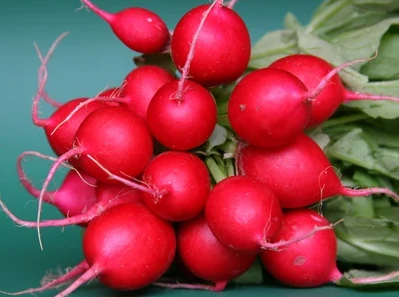
Table Radishes: Harvest radishes on time, typically 3–4 weeks after planting, when the roots are about the size of a large marble, depending on the variety. After harvesting, bunch or top the radishes, hydrocool them, and refrigerate. Topped radishes will remain in good, crisp condition for 3–4 weeks if stored at 32°F with 95% relative humidity and in breathable packaging.
Daikon Radishes: Harvest daikon by hand approximately 60 days after planting. For the processing market, roots are typically harvested at 12 to 14 inches in length, while for the oriental vegetable market, they are harvested at around 2.5 inches. Daikon can be sold with or without the tops attached, but leaving the tops on generally commands a better price.
To store, bunch or top the radishes, hydrocool them, and refrigerate. Topped daikon will keep in good, crisp condition for 3–4 weeks at 32°F with 95% relative humidity and breathable packaging. Daikon can last 3–4 months in the same conditions. Throughout the growing season, a steady supply of water is essential. Lack of moisture leads to irregular maturity and poor-quality roots, while moisture stress can exacerbate scab in radishes.
Radishes are at their optimum size for harvest for about 3 days during the summer and 5 to 7 days during cooler weather. After this period, they become oversized and pithy. To ensure proper harvest timing, check radishes daily as they approach maturity. They are typically harvested with a machine that removes the tops and are handled in bulk from the field until packed. Hydrocooling before packing helps improve shelf life.
According to USDA grade standards, the minimum size for red radishes is 5/8 inch in diameter, with no maximum size. However, the most marketable size is between 7/8 and 1 1/8 inches in diameter. Radishes are usually packed into 6-ounce or 1-pound plastic bags, then packed in 12- to 15-pound cartons. For bunched radishes, there should be 18 to 20 radishes per bunch, with no more than a ½-inch diameter variation among the radishes in each bunch.
There are no products listed under this category.