There are no products listed under this category.


Start with the variety: The spacing information in this guide provides general principles and starting ranges. When a specific spacing recommendation is provided for an individual Holmes Seed pumpkin variety, follow the variety-specific recommendation.
Spacing determines how much growing area is available to each plant and how many plants are established in a garden or field. Pumpkin vines compete for sunlight, water, nutrients, and physical space as the canopy develops.
Plant density influences competition among neighboring plants for light, water, nutrients, and growing area.
Spacing influences canopy density, light penetration, and air movement around leaves and vines.
Row width can affect cultivation, irrigation, scouting, harvest access, and the equipment that can move through a planting.
Closer spacing increases the number of plants that can be grown in a given area, while wider spacing provides more growing area per plant. The best balance depends on the variety and production system.
One of the most important characteristics to consider when spacing pumpkins is growth habit. Varieties may be described as bush, compact, semi-bush, semi-vine, short-vine, or vining.
Bush types generally occupy less growing area and can be planted at higher populations. Traditional vining pumpkins produce longer vines and require more room. Semi-vine types fall between these two growth habits.
Important: Fruit size and vine habit are separate characteristics. A miniature pumpkin can grow on a vigorous vine, while a larger-fruited variety may have a more compact plant habit. Do not use fruit size alone to determine spacing.
There is no universal pumpkin spacing chart. University Extension recommendations vary with cultivar, region, equipment, and production system. The ranges below are useful starting ranges based on published recommendations. Use variety-specific spacing information when it is available.
| Growth Habit | Approx. In-Row Spacing | Approx. Row Spacing |
|---|---|---|
| Bush / Compact | About 1 1/2–3 ft | About 4–6 ft |
| Semi-Bush / Semi-Vine | About 2–4 ft | About 6–8 ft |
| Vining | About 2–5 ft | About 6–12 ft |
These ranges intentionally overlap. For example, Southeastern Extension guidance recommends approximately 2–3 feet between bush plants with 5–6 foot rows, 2–4 feet between semi-vine plants with 6–8 foot rows, and 4–5 feet between vine plants with 8–10 foot rows. Other production systems use somewhat different spacings.
Fruit size can help refine plant population, but fruit size alone should not determine spacing. Commercial recommendations often use lower plant populations for large-fruited pumpkins and higher populations for smaller-fruited pumpkins, but growth habit remains an important consideration.
Do not assume small fruit means a small plant. When choosing a pumpkin for limited space, look for descriptions such as bush, compact, short-vine, or semi-vine rather than relying on fruit size alone.
These varieties produce relatively limited vine growth and generally allow higher plant populations. They are especially useful where growing area is limited.
These pumpkins produce more vine growth than bush types but remain more compact than vigorous traditional vines.
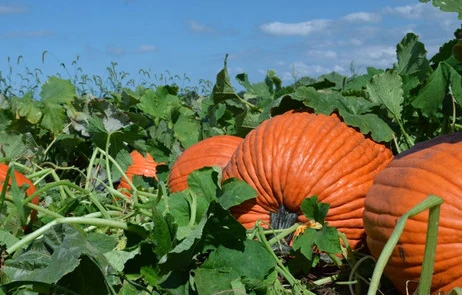
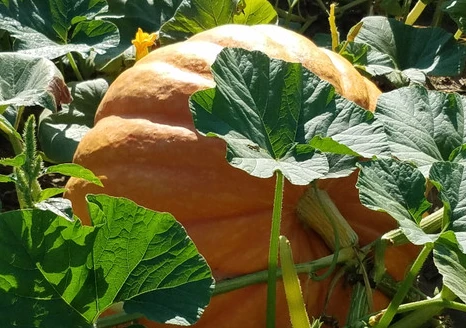
Traditional vining pumpkins can develop long main vines and lateral growth, requiring substantially more growing area than compact types.
Pumpkin planting instructions often refer to planting in hills. The term can refer to a planting station where seeds are grouped together. In some garden systems, the soil at that planting location may also be slightly raised or mounded.
Several seeds may initially be planted at a hill and later thinned after emergence. The number of plants retained and the distance between hills should follow the recommendation for the variety and production system being used.
Closer spacing increases plant population but also increases competition among neighboring plants. This can affect canopy development, access to resources, and fruit production. Depending on the variety and growing conditions, increasing plant density may also influence average fruit size.
More plants can be established per acre or garden area, but competition among plants increases as density rises.
Fewer plants occupy the same area, providing more individual growing space and reducing competition between neighboring plants.
Spacing does not override the genetics of the variety. Final fruit size and yield are influenced by cultivar, plant density, fruit load, pollination, moisture, fertility, weather, and other growing conditions.
Commercial growers often think about pumpkin spacing in terms of plants per acre. When one plant is established at each regular spacing position, approximate plant population can be calculated using row spacing and in-row spacing.
Plants per Acre = 43,560 ÷ (Row Spacing in Feet × In-Row Spacing in Feet)
Example: Pumpkins planted 3 feet apart in rows spaced 8 feet apart:
43,560 ÷ (3 × 8) = approximately 1,815 plants per acre
This calculation assumes one plant at each spacing position. Planting systems that retain multiple plants at each hill or station require the population calculation to be adjusted accordingly.
Commercial pumpkin populations vary considerably. University of Georgia Extension reports pumpkin populations ranging from approximately 600 to 3,000 plants per acre, depending on factors such as vine habit, equipment, and grower preference.
Approximately 2,000–3,000 plants per acre in UGA's published commercial system.
Approximately 1,500–2,000 plants per acre in UGA's published commercial system.
Approximately 1,000–1,200 plants per acre in UGA's published commercial system.
These populations are examples from one Extension production system rather than universal targets. Penn State, for example, reports commercial populations of approximately 1,600 plants per acre for pumpkins over 30 pounds and approximately 2,800 plants per acre for pumpkins under 8 pounds in its production system. Regional recommendations and individual variety requirements should be considered when establishing a target population.
Rather than choosing spacing from fruit size alone, consider the variety and production system together.
There is no single correct spacing for every pumpkin variety.
Start with the growth habit and spacing recommendation of the individual variety. Then consider fruit size, available growing area, equipment, target plant population, and production goals. Bush and compact varieties generally allow higher plant populations, while vigorous vining pumpkins require more growing area. For Holmes Seed varieties with a specific spacing recommendation, use that variety-specific information as your primary guide.
There are no products listed under this category.