There are no products listed under this category.


Yes. Pumpkin seeds contain a combination of protein, fats, carbohydrates, fiber, minerals, and naturally occurring plant compounds. Their exact nutritional composition varies with the pumpkin variety, growing environment, processing method, and whether the hull is included.
Pumpkin seed kernels provide substantial plant-based protein, making them a nutrient-dense addition to snacks and foods.
Pumpkin seeds contain oil rich in unsaturated fatty acids. This oil content is one reason specialized oilseed pumpkins are commercially valuable.
Pumpkin seeds provide minerals including magnesium, phosphorus, potassium, iron, and zinc. The amounts vary among seed types and varieties.
Pumpkin seeds also contain naturally occurring compounds including tocopherols, commonly referred to as forms of vitamin E, as well as phytosterols and other phytochemicals. Nutritional composition should not be considered identical among all pumpkin varieties or seed products.
A pumpkin seed contains the embryo and nutrient-storing tissues surrounded by protective seed-coat tissues. In a conventional pumpkin seed, portions of the seed coat develop thick, strengthened cell walls containing lignin and other structural materials. This produces the familiar firm, pale-colored hull surrounding the kernel.
Hull-less pumpkin seeds develop differently. They do not form the normal thick, heavily lignified hull, leaving the edible kernel covered by much thinner seed-coat tissue.
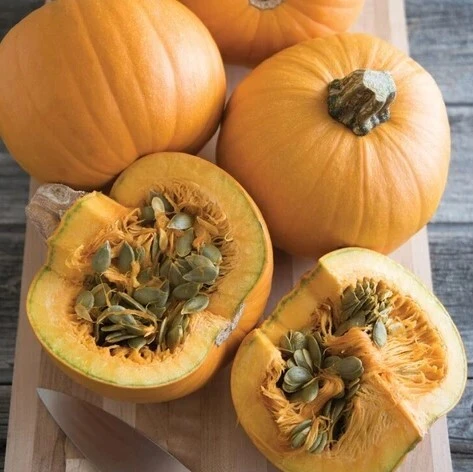
Most familiar pumpkin varieties produce conventional seeds with a firm outer hull. These are the pale or cream-colored seeds commonly removed from carving, pie, and other pumpkins.
The hull does not make a pumpkin seed inedible. Conventional pumpkin seeds can be roasted and eaten with the hull intact. Some people prefer removing especially thick or fibrous hulls before eating the kernel.
Hull-less pumpkins, also called naked-seeded or oilseed pumpkins, are specialized pumpkins selected for seeds that do not develop the normal thick, lignified hull. Instead, the kernel is surrounded by thin, membranous seed-coat tissue.
The trait has been extensively studied in Cucurbita pepo, the species that includes many familiar pumpkins and summer squash. Hull-less varieties are particularly useful when the seed itself is the desired crop because the kernel does not require conventional dehulling before eating or processing.
The naked-seed characteristic is a genetic trait. It is not caused by harvesting the seed early or removing the hull after harvest.
Research on hull-less Cucurbita pepo has shown major differences in the development of the seed coat. In normal hulled seeds, several seed-coat cell layers develop strong secondary cell walls and become lignified as the seed matures. In hull-less types, normal secondary cell-wall development and lignification are greatly reduced or disrupted, so these tissues do not form the same hard protective hull.
In simple terms: A naked pumpkin seed is not a conventional pumpkin seed with its shell removed. The pumpkin is genetically different in how its seed coat develops.
The word pepita is commonly used for the green edible portion of a pumpkin seed. In U.S. food markets, the term is often associated with either kernels that have been removed from conventional hulls or the naturally hull-less green seeds produced by specialized pumpkin varieties.
For growers, the important distinction is whether the pumpkin genetically produces a conventional hard hull or a naturally hull-less seed. A green kernel sold as a pepita does not, by appearance alone, tell you whether it was mechanically dehulled or naturally produced by a hull-less pumpkin.
Hull-less should not automatically be interpreted as more nutritious. Pumpkin seed composition varies with genetics, variety, growing conditions, processing, and whether the analysis includes the hull or only the kernel.
Hull-less varieties are especially valuable because their kernels are readily accessible without removing a thick seed coat. Conventional seeds, however, are also nutritious and edible. The presence or absence of a hull is primarily a structural and processing difference rather than a simple measure of nutritional quality.
| Characteristic | Conventional Hulled Seed | Hull-Less or Naked Seed |
|---|---|---|
| Seed Coat | Firm, normally lignified outer hull | Normal thick hull does not develop; thin membranous tissue remains |
| Edible? | Yes, often roasted and eaten whole or dehulled | Yes, easily eaten without removing a hard hull |
| Processing | Kernel extraction requires removal of the hull | No conventional dehulling required |
| Typical Uses | Home roasting, snacks, culinary use | Snacking, baking, seed products, oil production |
| Pumpkin Type | Common across many pumpkin varieties | Specialized varieties selected for the hull-less trait |
Yes. Seeds from ordinary carving pumpkins are edible. They can be separated from the pulp, washed, dried, seasoned if desired, and roasted. Their hulls may be thicker than those of varieties selected specifically for seed eating, but the presence of the hull does not make them inedible.
For occasional home roasting, seeds from a carving or culinary pumpkin can work very well. Growers interested primarily in producing easy-to-eat kernels or seeds for commercial processing may prefer a variety bred specifically for hull-less seed production.
The best choice depends on how the seeds will be used. Nearly any sound pumpkin can provide seeds for home roasting, but specialized hull-less varieties are particularly useful when seed production is the primary goal.
Many carving and culinary pumpkins produce perfectly edible seeds. Seed size, hull thickness, and flavor can vary considerably among varieties.
Hull-less or naked-seeded varieties are particularly convenient because the edible kernel does not need to be separated from a hard outer hull.
Specialized oilseed pumpkins are selected for seed production and are valuable for pumpkin seed oil because eliminating the normal hard hull simplifies processing.
Both conventional and hull-less pumpkin seeds are edible and nutritious. The major difference is how the seed coat develops.
Conventional pumpkin seeds develop a firm, lignified outer hull that can be eaten or removed. Hull-less varieties are genetically different and do not develop the normal thick hull, making the kernels easier to eat and process. For home roasting, seeds from many pumpkins can be enjoyed. For specialized snack-seed or oil production, hull-less varieties offer a significant processing advantage.
There are no products listed under this category.